

10:00 AM - 9:00 PM (Mon - Sat)
10:00 AM - 2:00 PM (Sunday)



Why Your Child's First Dental Visit Matters More Than You Think


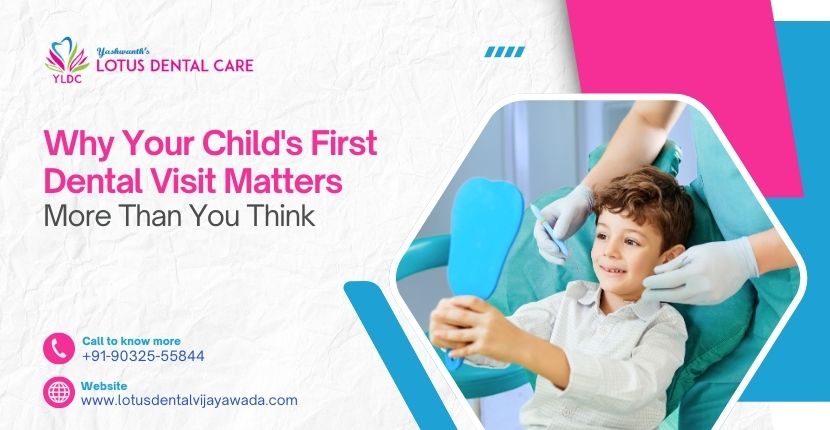
Most parents bring their child to us after something has already gone wrong. A toothache at midnight, a cavity spotted by the school nurse, or a tooth that looks a little off and has been quietly worrying them for weeks. We understand why it happens that way. Children don't complain about mild discomfort the way adults do, and dental visits don't always feel urgent until they suddenly are.
What we've seen over the years at Lotus Dental Care, a pediatric dental clinic in Vijayawada, is that the families who come in early, before there's a problem, almost always have an easier time. Easier visits, less treatment, less anxiety from the child, and far fewer of those late-night calls that no parent wants to make. Prevention in pediatric dentistry isn't a general principle. It's something we watch play out in real terms, with real children, week after week.
When Should a Child First See a Dentist
The answer surprises most parents: around the time the first tooth appears, or by the child's first birthday at the latest.
This isn't about doing extensive dental work on an infant. It's about a few specific things that matter a great deal at that stage:
- Checking that the first teeth are coming in correctly
- Reviewing feeding habits, including bottle use and breastfeeding, and how they affect early tooth health
- Showing parents how to clean an infant's teeth and gums properly
- Creating an early association between the dental environment and something calm and normal
That last point carries more weight than most people give it. Children who visit the dentist from a young age don't build up the same layers of fear and avoidance that come from a first visit being an emergency extraction or a filling. The dental chair becomes familiar before it becomes scary, and that changes everything about how treatment goes when it's actually needed.
Baby Teeth Are Not Disposable
One of the most persistent misconceptions we encounter is that baby teeth don't matter much because they fall out anyway. This leads parents to delay treatment on a decayed baby tooth, reasoning that it will be gone soon enough.
The reality is more complicated than that. Baby teeth do a job that goes well beyond chewing:
- They hold space in the jaw for permanent teeth developing underneath
- When lost too early due to decay or infection, neighbouring teeth shift into the gap
- The permanent tooth loses its path, leading to crowding and alignment issues
- That crowding often means orthodontic treatment later, which could have been avoided
Beyond spacing, untreated decay causes real pain.
Children with dental pain eat less, sleep poorly, and in some cases miss school. The impact on their daily life is immediate, not theoretical.
When parents come to us at Lotus Dental Care, where we provide kids dental care in Vijayawada, with a child who has a badly decayed baby tooth, the conversation we have is never about the tooth in isolation. It's about everything connected to it.
What a Pediatric Dental Visit Actually Looks Like
We want parents to know what to expect, especially if they're bringing a young child for the first time. A visit to our clinic is not the same as a standard adult dental appointment, and it shouldn't be.
The environment is different. The pace is different. The way we communicate with children is different from how we speak to adults, and the treatment techniques we use are chosen specifically for young patients.
A typical first visit includes:
- A gentle examination of the teeth, gums, jaw, and bite
- A count of teeth present and a check on eruption patterns
- Cleaning and polishing if the child is comfortable with it
- Fluoride application to strengthen enamel against early decay
- X-rays only if there's a specific clinical reason, not as routine for very young children
- A conversation with the parent about diet, habits, and home care
We spend a portion of every first visit simply letting the child get comfortable. Showing them the instruments, explaining what each one does, and letting them touch things if they want to. Children respond well to being included rather than worked on, and that approach changes the quality of every visit that follows.
The Problems We See Most Often in Children
Across years of practice as a kids dental hospital in Vijayawada, the same concerns come up with regularity. Knowing what to watch for helps parents catch things early.
- Early childhood caries: This is the clinical term for decay that develops in young children, often linked to prolonged bottle feeding with sweetened liquids or milk at bedtime. It progresses faster in baby teeth than in permanent ones and can affect multiple teeth at once.
- Thumb sucking and pacifier habits: Occasional thumb sucking in infants is normal. When it continues past age three or four, it can begin to affect how the front teeth come in and how the jaw develops. We address this gently and without making the child feel shamed for it.
- Delayed or early tooth eruption: Most children follow a rough timeline for when teeth appear and fall out. Significant deviation from that pattern is worth checking.
- Grinding: Many children grind their teeth during sleep. Mild cases often resolve on their own, but persistent grinding can wear down enamel and sometimes signal other issues worth looking into.
- Gum issues: Swollen or bleeding gums in children are not normal and are usually a sign of inadequate brushing or, less commonly, an underlying condition.
If any of these are present, early intervention is always simpler and less invasive than waiting until the problem has progressed.
Raising a Child To Not Be Afraid of the Dentist
This is something we genuinely care about at Lotus Dental Care, and it shapes how we run every appointment.
Dental anxiety in adults almost always traces back to a difficult experience in childhood. A painful procedure that wasn't explained. A dentist who moved too quickly. A first visit that happened in the middle of a dental emergency. These experiences settle into a child's memory and follow them for decades.
Our goal with every young patient is not just to treat their teeth. It's to make sure they leave our clinic without fear. That means we go at the child's pace. We explain before we do. We stop if a child is overwhelmed and give them a moment. We celebrate small things, like sitting in the chair calmly or opening their mouth without hesitation, because these are genuinely worth acknowledging for a young child.
Parents often tell us that their child asks to come back. That feedback means more to us than anything else.
The First Visit Is the One That Sets the Tone for Everything After
We built our pediatric dental clinic in Vijayawada around a simple belief: children deserve dental care that was designed for them, not scaled down from adult care. The techniques, the environment, the communication style, and the pace of treatment all reflect that.
If your child hasn't seen a dentist yet, or if it's been a while, the best pediatric dentist in Vijayawada for your child is the one they feel safe with. Let Lotus Dental Care be that for your family.
Come in when things are calm, not just when something hurts. That one decision makes every visit after it easier for everyone, especially your child.
Visit Now!
Yashwanth's Lotus Dental Care Vijayawada
Address: Lotus Landmark Internal Road, Lotus Landmark, Kedareswar Pet, Vijayawada, Andhra Pradesh 520003
Phone: +91 9032555844